1. Lesson Objective
Writing is rewriting. The first draft is just you telling yourself the story. The edit is where you tell the story to the reader. In this lesson, we will learn how to approach the daunting task of revision, breaking it down into manageable stages so you don't get overwhelmed.
2. What You Will Learn
- The "Cooling Off" period and why it's essential.
- The difference between Structural Editing (Macro) and Line Editing (Micro).
- How to kill your darlings (ruthlessly).
- A checklist for the final polish.
3. Required Knowledge or Tools
You need a completed draft (or at least a completed scene). You also need a red pen (or the "Track Changes" feature). Most importantly, you need to detach your ego from the work.
4. Core Concept Explanation
The Sculptor's Block
Imagine your first draft is a giant block of granite. It looks vaguely like a horse, but it's rough, heavy, and ugly. Editing is the process of chipping away everything that doesn't look like a horse. You cannot polish the granite until you have carved the shape.
Phase 1: Structure. Does the story make sense? Are the plot holes filled?
Phase 2: Line Edit. Is the pacing right? Is the dialogue sharp?
Phase 3: Copy Edit. Spelling, grammar, and typos.
Kill Your Darlings
This famous advice (attributed to Faulkner) means you must delete anything that doesn't serve the story, even if you love it. That beautiful paragraph describing the sunset? If it stops the action dead, it has to go.
5. Why This Lesson Matters
A brilliant idea poorly executed is worthless. A mediocre idea brilliantly executed can be a bestseller. Editing is where the magic happens. It turns "good enough" into "great." If you submit a first draft to an agent or publisher, it will be rejected. You must respect the craft enough to refine it.
6. Step-by-Step Tutorial: The Editing Funnel
Step 1: The Big Read
Read your entire draft without stopping to fix anything. Just take notes. "Chapter 3 is boring." "Character A disappears in Chapter 5." This gives you the 30,000-foot view.
Step 2: The Structural Fix
Move chapters around. Delete scenes. Combine characters. Fix the plot holes. This is the heavy lifting. Do not worry about commas yet.
Step 3: The Line Edit
Now go sentence by sentence. Look for:
- Passive voice ("The ball was thrown by him" -> "He threw the ball").
- Weak verbs.
- Repetitive words.
- Clichés.
Step 4: The Read Aloud
Read your story out loud. Your ear will catch clunky rhythms and awkward phrasing that your eye missed.
7. Visual Explanation
The image below depicts the editing process as a filter or funnel.
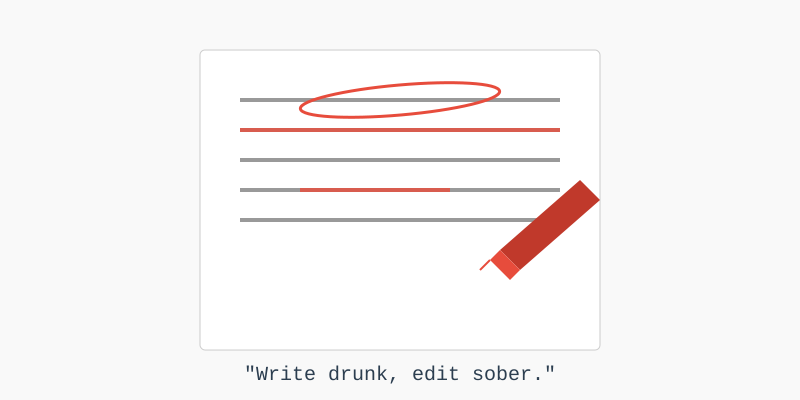
We start with chaos and end with order. The red pen is your best friend.
8. Common Mistakes and Misunderstandings
- Editing While Writing: We mentioned this in Lesson 1, but it bears repeating. Do not edit until the draft is done. Switching between "Creative Brain" and "Critical Brain" causes fatigue.
- Being Too Gentle: Don't just tickle the sentences. Cut them. If a scene doesn't have conflict, cut it. If a character doesn't have a purpose, cut them.
- Relying on Spellcheck: Spellcheck won't tell you that you wrote "their" instead of "there," or "martial" instead of "marital." Trust your eyes.
9. Practical Example or Scenario
Draft: "He started to walk towards the door, feeling a sense of trepidation that he couldn't quite explain, wondering if perhaps he should turn back." (26 words, passive, wordy).
Edit: "He crept toward the door, heart hammering. Should he turn back?" (11 words, active, punchy).
The edit cuts the word count by more than half and doubles the impact.
10. Lesson Summary
In this lesson, we learned that editing is a multi-stage process involving structural repair, line polishing, and proofreading. We embraced the philosophy of "Killing Your Darlings" and discussed the importance of reading aloud.
Homework: Take the first page of your story. Cut 10% of the words without losing any meaning. It is harder than it sounds, but your writing will be stronger for it.