1. Lesson Objective
Pacing is the speed at which the story unfolds. It is the invisible hand that controls the reader's heart rate. In this lesson, we will learn how to manipulate time—slowing it down for emotional impact and speeding it up for action sequences.
2. What You Will Learn
- How sentence length dictates reading speed.
- The "Scene vs. Sequel" structure for managing energy.
- How to use white space to create urgency.
- Techniques for skipping the boring parts.
3. Required Knowledge or Tools
You need a scene that feels "draggy" or too fast. We will fix it.
4. Core Concept Explanation
Writing is Music
Gary Provost famously demonstrated that sentence length creates music.
Short sentences are staccato. They create tension. Fear. Action.
Long, flowing sentences that meander through clauses and commas create a sense of relaxation, introspection, or romance.
To write well, you must vary the length. You must create a rhythm.
Scene and Sequel
A story needs a rhythm of action and reaction.
Scene (Action): Goal -> Conflict -> Disaster. (High Energy)
Sequel (Reaction): Emotion -> Thought -> Decision -> New Goal. (Low Energy)
If you have too many Action Scenes in a row, the reader gets exhausted. If you have too many Sequels, the reader gets bored.
5. Why This Lesson Matters
Bad pacing is one of the main reasons readers put a book down. If the beginning is too slow, they never get to the middle. If the ending is too rushed, they feel cheated. Controlling the flow allows you to emphasize what is important.
6. Step-by-Step Tutorial: Manipulating Speed
To Speed Up:
- Use short sentences. fragments even.
- Remove adjectives and adverbs.
- Use dialogue with little narration.
- Use active verbs.
- Example: "He ran. The door was locked. He kicked it. Splintered wood. He was in."
To Slow Down:
- Use long, complex sentences.
- Focus on sensory details and internal monologue.
- Describe the setting.
- Example: "As he stood before the ancient oak door, he traced the grain of the wood with a trembling finger, remembering the summer days he had spent here as a child, unaware of the darkness that lay within."
7. Visual Explanation
The image below visualizes pacing as a sound wave. Notice the difference between the sharp spikes of action and the smooth curves of introspection.
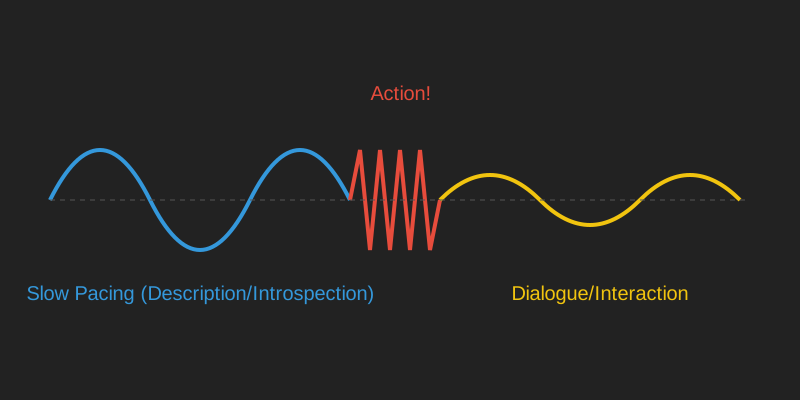
A good novel looks like a song with verses (slow) and choruses (fast).
8. Common Mistakes and Misunderstandings
- The "Traveling" Scene: We don't need to see the character drive to the airport, park the car, check in, and wait at the gate unless something important happens. Use a "cut" (transition). "Three hours later, he landed in Paris."
- Detailed Trivialities: Don't slow down to describe a cup of coffee unless the poison is in it.
9. Practical Example or Scenario
Action Scene (Fast): "The gun clicked. Empty. He threw it. It hit the thug in the face. The thug staggered. He punched. Hard. Bone crunched."
Romantic Scene (Slow): "The light filtered through the curtains, casting dust motes into a golden dance that seemed to suspend time itself. She looked at him, really looked at him, tracing the lines of worry that had etched themselves around his eyes over the long, hard winter."
10. Lesson Summary
In this lesson, we learned that pacing is controlled by sentence structure and detail. We discussed the importance of balancing action (Scene) with reaction (Sequel) to prevent reader fatigue.
Homework: Take an action scene and rewrite it using only sentences with 15 words or more. See how it ruins the tension. Then, fix it by chopping the sentences down.