1. Lesson Objective
A great character in a great setting is nothing without a great plot. Plot is the sequence of events that forces your character to change. In this lesson, we will learn the classic structures that have underpinned storytelling for thousands of years, ensuring your story has a satisfying beginning, middle, and end.
2. What You Will Learn
- The "Freytag's Pyramid" and how it applies to modern storytelling.
- The function of the Inciting Incident.
- How to navigate the "Sagging Middle."
- The difference between Plot (what happens) and Story (why it matters).
3. Required Knowledge or Tools
You need your protagonist and their goal. Now we are going to throw rocks at them.
4. Core Concept Explanation
Structure is a Skeleton
Some writers hate structure because they feel it limits their creativity. This is a mistake. Structure is not a formula; it is a form. Just as a human body needs a skeleton to stand upright, a story needs structure to hold its shape. Without it, you have a blob of disconnected scenes.
The Classic Arc
Aristotle defined it simply: A beginning, a middle, and an end. But we can break it down further:
Status Quo: Life as usual.
Disruption: Something changes (Inciting Incident).
Struggle: The character tries to fix it and fails (Rising Action).
Crisis: The point of no return (Climax).
New Status Quo: Life has changed forever (Resolution).
5. Why This Lesson Matters
Have you ever watched a movie that started great but got boring in the middle? Or a book that had a terrible ending? That is a failure of structure. Understanding pacing and plot points ensures that you keep your reader engaged from page one to "The End." It helps you identify why a scene isn't working.
6. Step-by-Step Tutorial: Mapping Your Plot
Step 1: The Inciting Incident
This is the event that kicks the story into motion. It disrupts the hero's life.
Example: Katniss's sister is reaped for the Hunger Games.
Step 2: The Door of No Return (Plot Point 1)
The hero decides to engage with the problem. They leave their comfort zone.
Example: Katniss volunteers as tribute.
Step 3: The Midpoint
A major event shifts the context. The hero stops reacting and starts acting.
Example: Katniss teams up with Rue (or Rue dies), changing the stakes from survival to rebellion.
Step 4: The Climax
The hero faces the antagonist. They must use everything they have learned.
Example: Katniss and Peeta threaten suicide with the berries.
Step 5: The Resolution
The aftermath. We see how the hero has changed.
Example: Katniss returns home, traumatized but alive.
7. Visual Explanation
The diagram below, known as Freytag's Pyramid, illustrates the rise and fall of tension in a narrative.
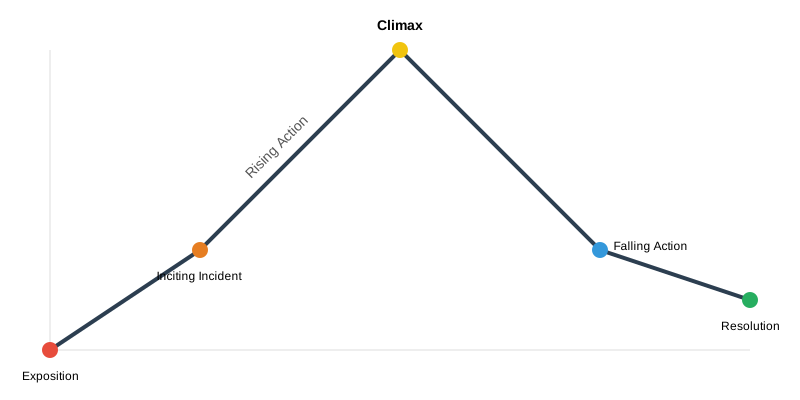
Note that the "Rising Action" is the longest part of the story. This is where most of the book happens.
8. Common Mistakes and Misunderstandings
- The Deus Ex Machina: This is Latin for "God from the Machine." It happens when the hero is saved by a random event (e.g., the cavalry arrives just in time) rather than their own actions. The hero must save themselves.
- Coincidence: Coincidences that get characters into trouble are great. Coincidences that get characters out of trouble are cheating.
- Lack of Stakes: If the hero fails, what happens? If the answer is "nothing much," you have no story. Raise the stakes.
9. Practical Example or Scenario
Let's map a simple Romance plot.
- Inciting Incident: Girl meets Boy. They hate each other.
- Rising Action: They are forced to work together on a project. They start to respect each other.
- Midpoint: They share a vulnerable moment. They realize they might be in love.
- All Is Lost (Pre-Climax): A misunderstanding separates them.
- Climax: Boy chases Girl to the airport to confess his feelings.
- Resolution: They kiss. Happy ever after.
Even simple stories follow this ancient pattern because it mirrors the way humans experience problem-solving.
10. Lesson Summary
In this lesson, we demystified plot structure. We learned that every story is a journey from a problem to a solution, punctuated by specific milestones like the Inciting Incident and the Climax. We also warned against "Deus Ex Machina" endings.
Homework: Take a favorite movie or book and try to identify the 5 key plot points. Where does the inciting incident happen? When is the midpoint? Write them down.