1. Lesson Objective
F. Scott Fitzgerald said, "Character is plot, character is plot." In this lesson, we will learn how to build characters that are so real they feel like they are in the room with you. We will move beyond physical descriptions and dive into the psychology that drives human behavior.
2. What You Will Learn
- The crucial difference between a character's WANT and their NEED.
- How to create sympathetic flaws.
- The "Ghost" (or wound) from the past that haunts the present.
- How to fill out a comprehensive Character Profile.
3. Required Knowledge or Tools
You will need the story idea you selected from Lesson 2. Today, we populate that world.
4. Core Concept Explanation
Want vs. Need
This is the engine of all great character arcs.
The Want: This is the external goal. The character is conscious of this. (e.g., "I want to win the championship," "I want to marry the prince.")
The Need: This is the internal lesson. The character is often unconscious of this initially. (e.g., "I need to learn that teamwork is more important than glory," "I need to learn self-worth.")
The story is the journey of the character pursuing their Want, only to discover their Need.
The Fatal Flaw
Perfect characters are boring. A flaw makes a character relatable. It is the thing that stops them from achieving their goal. It could be pride, cowardice, addiction, or a short temper. The climax of the story usually forces the character to overcome this flaw.
5. Why This Lesson Matters
Readers may come for the plot (the explosion, the murder mystery), but they stay for the characters. If we don't care about the person running from the dinosaur, the dinosaur isn't scary. Developing deep characters ensures that your audience is emotionally invested in the outcome. Without this investment, your story is just a series of events happening to strangers.
6. Step-by-Step Tutorial: Creating Your Protagonist
Step 1: The Questionnaire
Answer these three questions for your main character:
- What do they want more than anything in the world? (e.g., Revenge against the man who killed their father).
- What are they afraid of? (e.g., Intimacy/Vulnerability).
- What is their secret? (e.g., They are actually the villain's child).
Step 2: The Ghost
Determine a traumatic event from their past that shapes their worldview. This is called the "Ghost." If a character doesn't trust men, why? Did her father leave? Did a boyfriend betray her? This backstory informs their present actions.
Step 3: The Contradiction
Give them a trait that contradicts their stereotype. A shy boxer. A clumsy assassin. A illiterate librarian. Contradictions create depth and intrigue.
7. Visual Explanation
The image below illustrates the internal mechanism of a character. Note the tension between the Want and the Need.
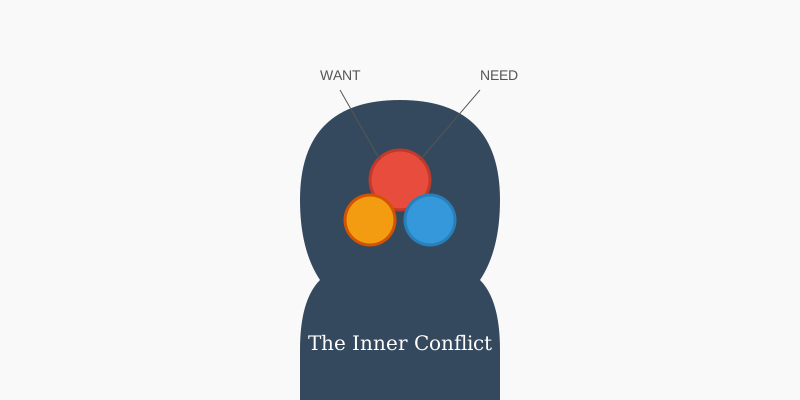
The gears represent the internal conflict. Until the Want and Need align (or clash), the character cannot move forward.
8. Common Mistakes and Misunderstandings
- The Mary Sue / Gary Stu: This is a character who is perfect at everything, loved by everyone, and has no flaws. They are wish-fulfillment for the author and boring for the reader. Give your hero a weakness!
- Passive Protagonists: Your hero must make choices. Things shouldn't just happen to them; they should make things happen. Even if they make the wrong choice, they must be active.
- Too Much Backstory: We don't need to know their favorite color or what they ate for breakfast in 1999 unless it's relevant to the plot. Reveal backstory slowly, like peeling an onion.
9. Practical Example or Scenario
Let's look at Walter White from Breaking Bad.
- Want (External): To make money for his family before he dies of cancer.
- Need (Internal): To feel powerful and alive after a life of mediocrity.
- Flaw: Pride/Ego.
- Ghost: Selling his share of a billion-dollar company for peanuts years ago.
Initially, we think he is doing it for his family (Want), but by the end, he admits, "I did it for me" (Need). This tragic realization is what makes the character arc so powerful.
10. Lesson Summary
In this lesson, we explored the psychology of character. We learned that a compelling protagonist needs a strong external goal (Want) and a subconscious internal lesson (Need). We also discussed the importance of flaws and backstory (The Ghost).
Homework: Create a "Dating Profile" for your protagonist. Include their photo (draw it or find a reference), their likes/dislikes, their biggest regret, and their perfect Sunday afternoon. Get to know them as if they were a real person.