1. Lesson Objective
Dialogue is the fastest way to improve—or ruin—a story. Great dialogue zings; it reveals character and advances the plot simultaneously. Bad dialogue is clunky, expository, or unrealistically formal. In this lesson, we will learn how to write dialogue that sounds like real people talking, only better.
2. What You Will Learn
- The difference between Real Speech and Dialogue.
- How to use Subtext (what is not said).
- The rules of Dialogue Tags (he said/she said).
- How to give each character a unique voice.
3. Required Knowledge or Tools
You need your characters. Do they use slang? Do they speak in long, academic sentences? Do they interrupt people?
4. Core Concept Explanation
Real Speech vs. Dialogue
Real speech is boring. It is full of "ums," "ahs," repetition, and small talk.
Real Speech: "Hey. How are you?" "Good, you?" "Yeah, good. Nice weather." "Yeah."
Dialogue: "We need to talk." "Not now, John."
Good dialogue cuts out the boring parts. It starts as late as possible and ends as early as possible.
Subtext
In real life, people rarely say exactly what they mean, especially when emotions are high. They talk around the subject. If a couple is fighting about the dishes, they are usually fighting about respect or love. The text is "You didn't wash the plate." The subtext is "You don't care about me."
5. Why This Lesson Matters
Dialogue breaks up the "Wall of Text" on the page. It speeds up the reading experience. More importantly, it is the primary way characters interact. If your dialogue is stiff, your characters will feel like robots. Mastering dialogue allows you to show relationships dynamically.
6. Step-by-Step Tutorial: Writing Subtext
Step 1: Write the "On the Nose" Version
Draft the scene where characters say exactly what they feel.
A: "I am angry that you cheated on me."
B: "I am sorry, but I felt lonely."
Step 2: Obscure the Meaning
Now, rewrite it so they are talking about something else, like a broken vase.
A: "You broke it."
B: "It was an accident. It just slipped."
A: "You're always so clumsy with things that matter to me."
Step 3: Add Action Beats
Use physical actions instead of dialogue tags to show emotion.
A: "You broke it." She didn't look up from her book.
B: He stared at the shards on the floor. "It just slipped."
7. Visual Explanation
The image below illustrates the concept of Subtext using the Iceberg Theory.
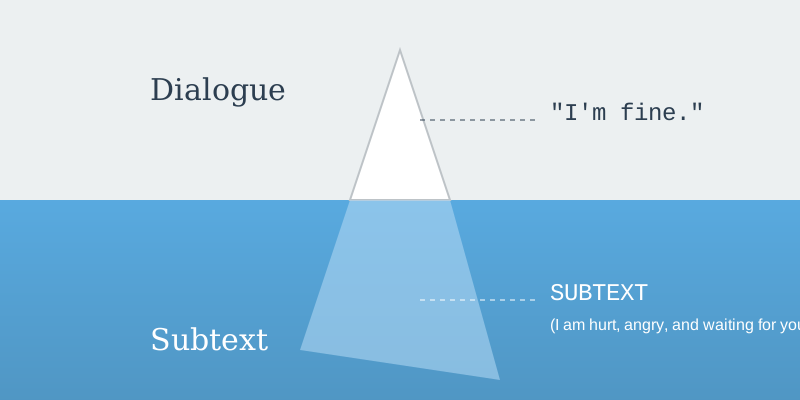
The reader reads the text, but they feel the subtext. The deeper the subtext, the more powerful the scene.
8. Common Mistakes and Misunderstandings
- "Said" Bookisms: Avoid using fancy tags like "he ejaculated," "she opined," or "he queried." Just use "said." It is invisible to the reader. If you need to show how it was said, use an action beat.
- The "As You Know, Bob" Exposition: This is when characters tell each other things they already know just to inform the reader.
Bad: "As you know, Bob, we have been brothers for 20 years since the war."
Fix: "You still drive like a maniac. Just like in Kabul." - Monologuing: Unless you are a Bond villain, people don't speak in paragraphs. Keep it snappy.
9. Practical Example or Scenario
Ernest Hemingway's Hills Like White Elephants is the masterclass in subtext. A couple waits for a train and talks about ordering drinks. They never mention the word "abortion," yet that is entirely what the story is about. The tension comes from what they are not saying.
10. Lesson Summary
In this lesson, we learned that good dialogue is condensed, purposeful, and layered with subtext. We discussed the importance of using "said" and avoiding expository dialogue.
Homework: Go to a coffee shop. Eavesdrop on a conversation for 5 minutes. Transcribe it. Then, edit it into a fictional dialogue by removing the filler, adding conflict, and enhancing the subtext.