1. Lesson Objective
The Point of View (POV) is the lens through which the reader experiences the story. Choosing the right POV is critical because it determines how much information the reader gets and how close they feel to the characters. In this lesson, we will analyze the pros and cons of the major perspectives.
2. What You Will Learn
- The mechanics of First Person ("I"), Second Person ("You"), and Third Person ("He/She").
- The difference between Third Person Limited and Third Person Omniscient.
- How POV affects reliability and suspense.
- How to avoid the dreaded "Head Hopping" mistake.
3. Required Knowledge or Tools
You need a basic understanding of pronouns. You also need to know who your protagonist is, as they are usually (but not always) the POV character.
4. Core Concept Explanation
First Person ("I")
Pros: Maximum intimacy. We are inside the character's head. We feel what they feel immediately.
Cons: Limited scope. We cannot know what is happening in another room unless the character is there. We only know what the character knows (and they might be lying).
Third Person Limited ("He/She")
Pros: A balance between intimacy and distance. The camera sits on the character's shoulder. We hear their thoughts, but the narrative voice can be more objective.
Cons: Still limited to one perspective at a time.
Third Person Omniscient ("God View")
Pros: The narrator knows everything—past, present, future, and the thoughts of all characters. Great for epic scopes (e.g., Lord of the Rings).
Cons: Creates distance. It's harder to forge a deep emotional bond with one specific character.
5. Why This Lesson Matters
The wrong POV can kill a story. Imagine Sherlock Holmes told from Sherlock's perspective. It would be boring because he solves the crime instantly. Told from Watson's perspective, it becomes a mystery because Watson is confused—just like the reader. The POV controls the flow of information.
6. Step-by-Step Tutorial: Choosing Your POV
Step 1: The Intimacy Test
Do you want the reader to be the character, or to watch the character? If you want deep psychological immersion (e.g., Catcher in the Rye), go with First Person. If you want a cinematic action feel, go with Third Person.
Step 2: The Scope Test
Does your story take place in multiple locations simultaneously? If so, you might need multiple POV characters (Third Person Limited, rotating chapters) or an Omniscient narrator.
Step 3: The Voice Test
Does your main character have a unique voice? If they speak in a funny or interesting way, First Person allows that voice to shine in every sentence.
7. Visual Explanation
The diagram below visualizes the "Cone of Vision" for each perspective.
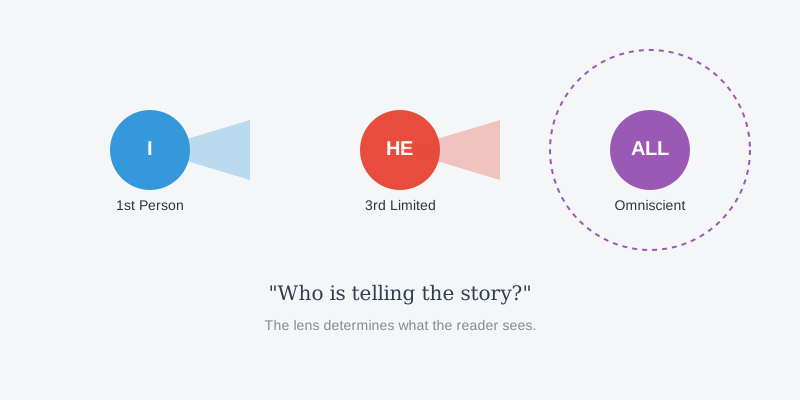
First Person is a spotlight. Omniscient is the sun.
8. Common Mistakes and Misunderstandings
- Head Hopping: This is the cardinal sin of modern writing. It happens when you are in "Third Person Limited" but you jump from one character's thoughts to another's within the same scene.
Bad: "John looked at Mary. He wondered if she was angry. Mary felt sad." (We just jumped from John's head to Mary's head).
Fix: Stick to one head per scene (or chapter). - The Unreliable Narrator: In First Person, remember that the character can lie or be wrong. This is a feature, not a bug. Use it to surprise the reader.
9. Practical Example or Scenario
Scenario: A bank robbery.
First Person (The Robber): "My heart pounded against my ribs. The mask scratched my face. I screamed at the teller, praying she wouldn't press the alarm." (Focus on fear and intent).
Third Person Omniscient: "The robber, a desperate man named Jack, screamed at the teller. He didn't know that the teller, Sarah, had already pressed the silent alarm five seconds ago. Meanwhile, outside, the police were silently surrounding the building." (Focus on dramatic irony and the big picture).
10. Lesson Summary
In this lesson, we analyzed the different Points of View available to a writer. We learned that POV is not just about pronouns; it is about information management. We also identified "Head Hopping" as a critical error to avoid.
Homework: Take a scene you have written (or a scene from a book) and rewrite it in a different POV. If it was "I", change it to "He". Notice how the tone shifts.