1. Lesson Objective
Without conflict, there is no story. If everyone is happy and gets what they want, the reader will fall asleep. In this lesson, we will learn how to torture our characters (lovingly) to keep the pages turning. We will distinguish between simple conflict and dramatic tension.
2. What You Will Learn
- The formula: Conflict = Desire + Obstacle.
- The difference between Tension (Anticipation) and Surprise (Shock).
- How to inject micro-tension into every scene.
- The types of conflict: Man vs Man, Man vs Self, Man vs Nature.
3. Required Knowledge or Tools
You need a sadistic streak. You must be willing to make life difficult for the characters you love.
4. Core Concept Explanation
Desire + Obstacle
Every scene must have a character who wants something and something that stands in their way.
Desire: I want to buy a coffee.
Obstacle: I forgot my wallet.
Conflict: I have to beg the barista or steal the coffee.
Hitchcock's Bomb Theory
Alfred Hitchcock explained the difference between Surprise and Suspense perfectly.
Surprise: Two people are talking. A bomb goes off. The audience is shocked for 10 seconds.
Suspense: The audience sees the bomb under the table. The timer says 5 minutes. The two people are talking about baseball. The audience screams, "Don't talk about baseball! Run!" This provides tension for 5 minutes.
5. Why This Lesson Matters
Tension is the glue that holds the reader's attention. It raises a question in the reader's mind: "Will they succeed?" If the answer is obvious, there is no tension. You must keep the outcome in doubt for as long as possible.
6. Step-by-Step Tutorial: The "But" and "Therefore" Method
South Park creators Matt Stone and Trey Parker use this method to ensure narrative momentum.
Step 1: Replace "And Then"
If your plot summary looks like "This happened, and then this happened, and then this happened," it is boring. It's just a list.
Step 2: Use "But" and "Therefore"
Every beat should cause the next one.
Example: The hero wants to go to the prom (Desire).
BUT his car breaks down (Obstacle).
THEREFORE he steals his dad's bike (Action).
BUT it starts to rain (Obstacle).
THEREFORE he arrives soaked and muddy (Consequence).
This creates a chain of cause and effect that feels inevitable.
7. Visual Explanation
The image below illustrates Hitchcock's Bomb Theory. The timer is the key to tension.
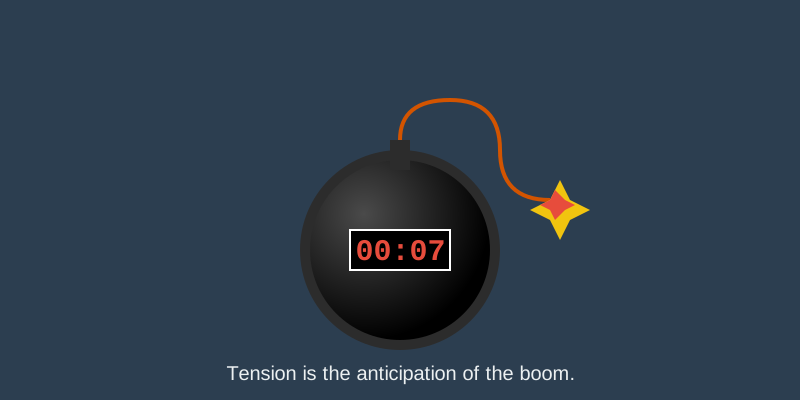
Tension is the gap between the current moment and the impending disaster.
8. Common Mistakes and Misunderstandings
- Bickering is not Conflict: Having characters argue over nothing is annoying, not dramatic. Real conflict comes from opposing goals, not just bad moods.
- Low Stakes: If the character fails, does it matter? If they can just try again tomorrow with no penalty, there is no tension. Failure must have a cost.
- Solving Problems Too Quickly: Don't let the hero win immediately. Let them struggle. Let them fail twice before succeeding on the third try.
9. Practical Example or Scenario
Scene without tension: A spy walks into a room, opens the safe, takes the documents, and leaves.
Scene with tension: A spy walks into a room. She hears footsteps in the hallway (Threat). She tries the safe combination—it's wrong (Obstacle). The footsteps get closer (Rising Stakes). She tries again—click. She grabs the papers. The door handle turns...
10. Lesson Summary
In this lesson, we learned that conflict is the fuel of story. We distinguished between surprise (short-term) and suspense (long-term). We also practiced the "But/Therefore" method to ensure our plot has strong causality.
Homework: Take a boring scene from your draft. Add a "Ticking Clock" (literally or figuratively). Give the character a deadline or a threat that forces them to act faster than they want to.