1. Lesson Objective
You have likely heard the golden rule of writing: "Show, Don't Tell." But what does it actually mean? In this lesson, we will move beyond the slogan and understand the mechanics of immersive writing. The objective is to learn how to evoke emotion in your reader rather than simply labeling it.
2. What You Will Learn
- The difference between "Conclusions" (Telling) and "Evidence" (Showing).
- How to use body language and dialogue to reveal internal states.
- When it is actually okay to "Tell" (yes, there are times!).
- How to remove "filter words" to increase immediacy.
3. Required Knowledge or Tools
You need a keen eye for human behavior. Start noticing how people express emotions physically. When your friend is lying, do they touch their nose? When they are angry, does their voice get quieter?
4. Core Concept Explanation
The Judge and Jury
Think of your reader as a jury and you as the lawyer.
Telling: "Ladies and gentlemen, the defendant is nervous." (This is a conclusion. The jury has to take your word for it).
Showing: "Ladies and gentlemen, look at the defendant. See how he is wiping sweat from his upper lip? See how his hands are shaking?" (This is evidence. The jury draws their own conclusion).
When readers draw their own conclusions, they are more engaged. They feel smart. They feel the emotion because they "discovered" it.
5. Why This Lesson Matters
"Telling" creates distance. It is a summary of an experience. "Showing" creates intimacy. It is a simulation of the experience. If you want your reader to cry, you cannot just say "It was a sad moment." You have to describe the empty chair at the dinner table, the silence in the hallway, the dust settling on the unread books.
6. Step-by-Step Tutorial: The Translation Game
Step 1: Identify the Abstract Label
Find a sentence in your writing that uses an abstract emotional label.
Example: "John was bored."
Step 2: Visualize the Action
Close your eyes. If you were watching a movie of John being bored, what would you see?
Visuals: Slumping in chair, checking watch, sighing, tapping pen.
Step 3: Write the Evidence
Replace the label with the visuals.
Revision: "John slumped in his chair, tapping his pen against the desk in a rhythm that matched the ticking clock. He checked his watch. Only two minutes had passed since the last time he checked."
7. Visual Explanation
The image below illustrates the transformation from an abstract statement to concrete details.
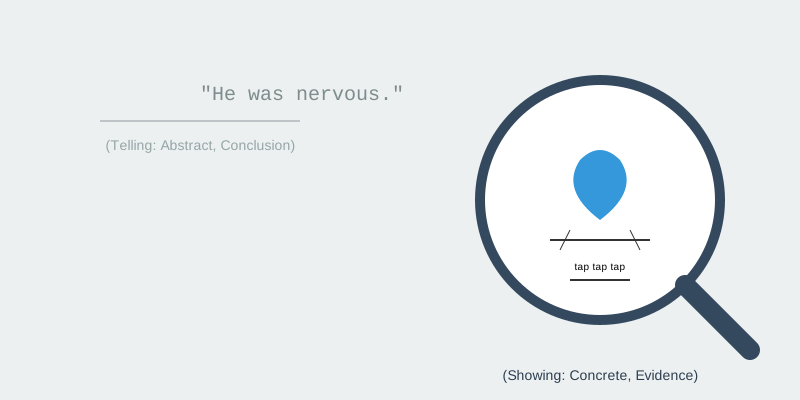
We zoom in on the physical reality to reveal the emotional truth.
8. Common Mistakes and Misunderstandings
- Showing Everything: You don't need to show everything. "He opened the door, stepped through, turned around, and closed it." No. Just say "He entered." Use "Showing" for high-emotion scenes; use "Telling" for transitions.
- The "Thought" Verbs: Words like "realized," "decided," "wondered" are often telling. Instead of "He realized he was lost," try "He stopped. The street signs were in a language he didn't recognize. He spun around, but the hotel was gone."
- Adverbs: Adverbs are often a crutch for weak verbs. "He closed the door firmly" (Telling) vs "He slammed the door" (Showing).
9. Practical Example or Scenario
Tell: "The house was spooky."
Show: "The front gate groaned as if in pain. Weeds clawed at the ankles of anyone who dared approach the porch. The windows were like empty eye sockets, staring blankly into the darkness."
Note how the second version never uses the word "spooky," yet it is infinitely more terrifying.
10. Lesson Summary
In this lesson, we mastered the art of "Show, Don't Tell." We learned that showing is about providing sensory evidence that allows the reader to deduce the character's emotions. We also learned that while showing is powerful, telling has its place in pacing and transitions.
Homework: Write a paragraph describing a character who is "impatient" without using the word "impatient" or any synonyms (anxious, annoyed, etc.). Focus entirely on their physical actions.